Skip to content
Ginhayaby Lyn Knecht

Lyn's Recipes

Five dishes, one island cuisine to cook at home

Behind every one of these classics lies a story – from pre-colonial preservation tricks to the festive roast. Cook them at your own pace.

Ingredients marked are available authentic in the Asia Boutique

Dish 01

Adobo

The unofficial national dish – older than its Spanish name
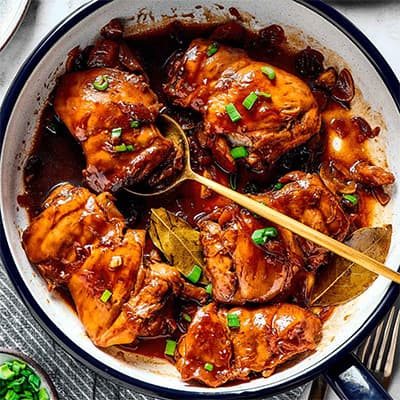
Adobo

Long before the Spanish arrived, people on the islands cooked their meat in vinegar and salt – simply because it kept food from spoiling in the tropical heat. Only in 1613 did a Spanish monk record the method in a dictionary, calling it “adobo”, from adobar = to marinate. So the name is European, the method thoroughly Filipino.

To this day every family has its own adobo – more soy sauce, more vinegar, with or without coconut milk. There is no official recipe. That is exactly what makes it the national dish: it belongs to everyone.

Servings4
Time55 min
LevelEasy

Ingredients

  • Chicken thighs (or pork belly)1 kg
  • Soy sauce120 ml
  • Vinegar (cane/coconut)80 ml
  • Garlic1 bulb
  • Bay leaves3–4
  • Black peppercorns1 tsp
  • Water250 ml
  • Sugar (optional)1 tsp

= available authentic in the Asia Boutique

Preparation

  1. Marinate the meat with soy sauce, crushed garlic and pepper for 30 min.

  2. Remove the meat and sear it all over in a pot.

  3. Add the marinade, vinegar, bay leaves and water. Don't stir the vinegar in right away – let it come to a boil first, then the sharp acidity mellows.

  4. Cover and simmer gently for 30–40 min, until the meat is tender.

  5. Uncover and reduce the sauce until syrupy. Season with sugar. Serve with rice.

Make it original

The flavour stands or falls with the soy sauce and vinegar. Get the authentic Filipino brands instead of supermarket substitutes.
Discover adobo ingredients

Dish 02

Sinigang

The sour soup – comfort food for an entire nation

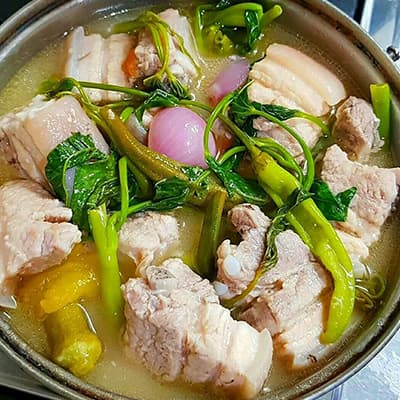
Sinigang

Sinigang is one of the islands' oldest dishes, probably of pre-colonial origin. Its principle is sourness: long before imported ingredients, cooks drew it from whatever grew – tamarind, starfruit, green mango, guava. A different souring agent by region and season, always the same warming result.

For many Filipinos a steaming bowl of sinigang is what chicken soup is elsewhere: comfort on rainy days, and the first thing they miss when living abroad.

Servings4–5
Time70 min
LevelEasy

Ingredients

  • Pork ribs or belly1 kg
  • Sinigang mix (tamarind)1 sachet
  • Onion & tomatoes2 each
  • Radish / daikon1
  • Eggplant, beans, okra1 handful each
  • Kangkong or spinach1 bunch
  • Patis (fish sauce)2 tbsp
  • Green chilli (optional)1–2

= available authentic in the Asia Boutique

Preparation

  1. Bring the meat to a boil with onion and tomatoes in 1.5 L water, skim, simmer for 45 min.

  2. Add the radish and eggplant, cook for 5 min.

  3. Stir in the sinigang mix – this gives the characteristic sourness.

  4. Add the beans and okra, simmer another 5 min.

  5. Finally add the leafy greens and chilli, season with patis. Serve hot with rice.

Make it original

The real tamarind sourness makes the difference. With the original sinigang mix you get it without hours of reducing fresh tamarind.

Discover sinigang mix

Dish 03

Lechon

The festive roast – centrepiece of every fiesta

Lechon

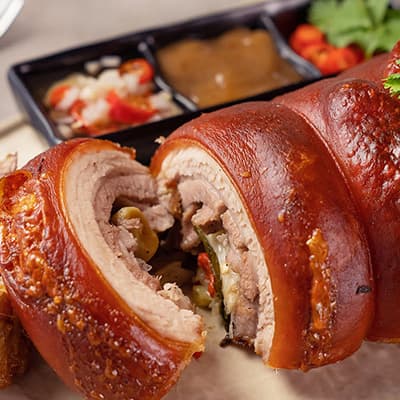
No Filipino celebration without lechon: the whole suckling pig, turned on a spit over embers, with glass-crisp skin. The Spanish brought the technique, yet on the islands it became a symbol of abundance and celebration – at Christmas, weddings, baptisms.

Cebu is considered the lechon capital; the travelling chef Anthony Bourdain once called the pig there the best he had ever eaten. At home the idea works best as crispy pork belly from the oven – without a spit, but with the same crackling.

Servings4–6
Time3 hrs
LevelMedium

Ingredients

  • Pork belly in one piece1.5 kg
  • Garlic1 bulb
  • Lemongrass (tanglad)3 stalks
  • Spring onions1 bunch
  • Bay leaves3
  • Salt & peppergenerous
  • Lechon sauce (Mang Tomas)to serve

= available authentic in the Asia Boutique

Preparation

  1. Score the meat side, season with garlic, pepper and bay. Lay on the lemongrass and spring onion, roll up tightly and tie.

  2. Pat the rind dry and salt it generously – that's the key to the crackling.

  3. Roast slowly at 160 °C for about 2 hrs, until the meat is tender.

  4. Raise the temperature to 230 °C for 25–30 min, until the skin puffs and turns glassy-crisp.

  5. Rest for 10 min, slice. Serve with lechon sauce.

Make it original

Crispy crackling calls for the sweet-savoury liver-based lechon sauce. Without it the typical taste is missing.

Discover lechon sauce

Dish 04

Pancit

The noodles of long life

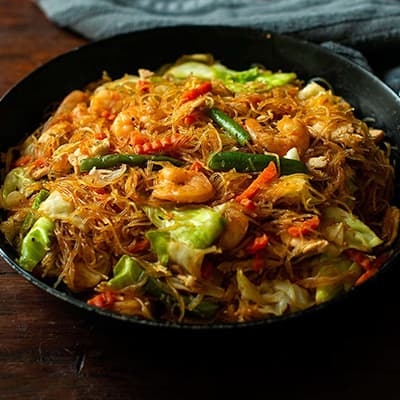
Pancit

Pancit came to the islands with Chinese traders – even the name derives from Hokkien “pian i sit”, “something conveniently cooked”. From the import grew an everyday cuisine with countless variations, from thin rice-noodle bihon to thick wheat canton.

At birthdays pancit must never be missing: the long noodles stand for a long life – and are therefore traditionally not cut, so you don't accidentally sever the good fortune.

Servings4
Time35 min
LevelEasy

Ingredients

  • Rice noodles (bihon)250 g
  • Chicken breast, sliced300 g
  • Prawns (optional)150 g
  • Carrot, cabbage, beans1 handful each
  • Soy sauce3 tbsp
  • Patis (fish sauce)1 tbsp
  • Chicken stock400 ml
  • Calamansi or lemonto serve

= available authentic in the Asia Boutique

Preparation

  1. Soak the rice noodles in water for 10 min, drain.

  2. Sauté garlic and onion, add the chicken (and prawns) and cook through.

  3. Add the vegetables, fry briefly until crisp-tender, remove.

  4. Bring the stock, soy sauce and patis to a boil, add the noodles and let them absorb the liquid.

  5. Fold in the vegetables and meat, serve with a squeeze of calamansi.

Make it original

Genuine Filipino bihon rice noodles and soy sauce are what make pancit authentic. Standard Asian noodles fall apart quickly.

Discover pancit ingredients

Dish 05

Lumpiang Shanghai

The crispy spring rolls of every celebration

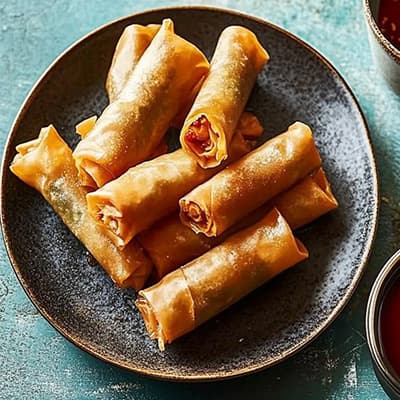
Lumpiang Shanghai

Lumpia, too, has Chinese roots – the word goes back to “lunpia”. In the Philippines it gave rise to a whole family of rolls: fresh (sariwa) or, most popular, the thin fried Lumpiang Shanghai with a minced-meat filling.

They are the secret star of every fiesta and buffet – rolled finger-length, deep-fried golden and crisp, gone in seconds. Hardly anyone stops at one.

Pieces~30
Time45 min
LevelMedium

Ingredients

  • Minced pork500 g
  • Lumpia wrappers1 pack
  • Carrot, finely diced1
  • Onion & garlic1 each
  • Egg1
  • Soy sauce2 tbsp
  • Salt, pepperto taste
  • Sweet-chilli or vinegar dipto serve

= available authentic in the Asia Boutique

Preparation

  1. Mix the pork with carrot, onion, garlic, egg, soy sauce, salt and pepper until well combined.

  2. Place 1 tbsp of filling on a wrapper, roll thin and tight into a finger-thick roll, seal the edge with water.

  3. Optionally halve for bite size.

  4. Deep-fry in batches in 170 °C oil until golden and crisp (3–4 min).

  5. Drain on kitchen paper, serve hot with the dip.

Make it original

Thin Filipino lumpia wrappers roll up more easily and turn crisper than thick pastry sheets – together with the matching dip.

Discover the lumpia set

Cook it original, savour it original

Every ingredient marked is found in our Asia Boutique – fresh Filipino specialities, carefully selected and delivered across Switzerland.